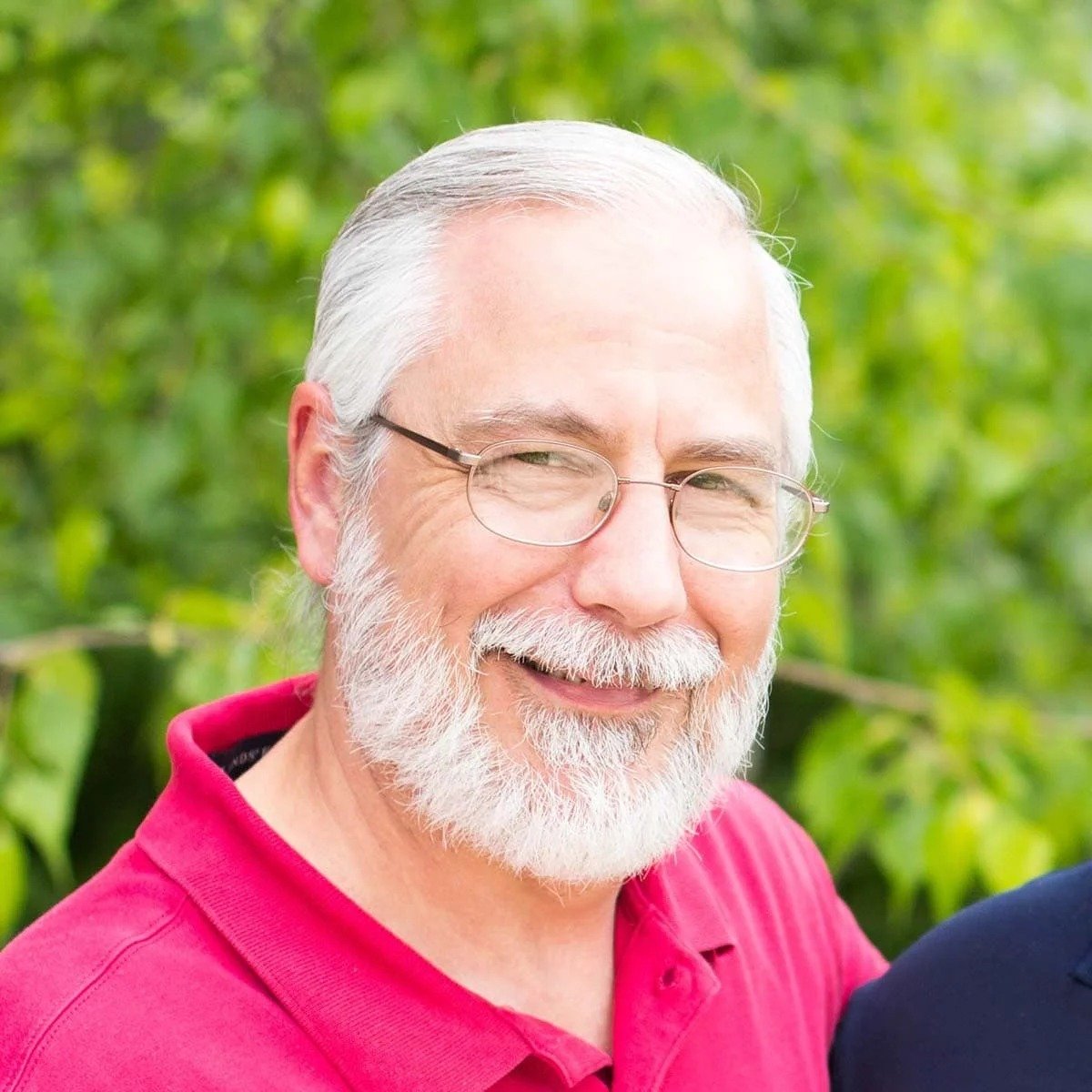
A lifelong interest in science and a master’s degree in systems engineering put Dr. C. John “Jack” Collins on track to pursue a career in that field, but an equally strong interest in linguistics—and the persistent desire to study and teach the Bible—changed his trajectory. Dr. Collins, who is retiring from Covenant after 32 years of faithful service (see “Faculty & Staff” in this issue), shared his story in this recent interview.
Rick Matt (RM): Let’s begin with a little bit of your background. Where are you from originally? What was your faith situation like?
Jack Collins (JC): My parents are from the New York City area, but I was born in Knoxville, Tennessee. My father was a troubleshooting manager for RCA and moved around a lot to various branches and districts. We then lived in Atlanta until I was five, then in New Jersey until I was 10, then here in Missouri for a while, where my older brother became a friend of the Chapell family. He was converted through the influence of [former CTS President and current Stated Clerk of the PCA] Bryan Chapell’s older brothers. Bryan and I were classmates in school, but we didn’t know each other very well at the time. Then my family moved to the Chicago area and from there to the Boston area.
As to my faith background, my father was a lapsed Catholic. Having served in the Second World War and so forth, he was pretty bitter about religion. My mother had been raised a Missouri Synod Lutheran. So, my siblings and I were nominally Christian. I did make a sort of profession of faith when we lived in Chicago but didn’t really come to a living faith until my second year of college. I went to MIT with the intent of studying math and physics and ended up in computer science and systems engineering. My brother’s faith had really taken hold, though, and during Christmas break in my second year at MIT, he invited me to a Navigators conference. That’s where I was converted, just over 50 years ago now. After that I finished a BS and MS at MIT, then worked in the Boston area for three years before going to seminary.
In the meantime, as I grew in my Christian faith and led Bible studies with the Navigators, a new student came into my Bible study. Her name was Diane, and she eventually became my wife. We were married in 1979. She also completed her BA and MA at MIT, while I was working. After that, we moved to Washington State, where I went to Faith Lutheran Seminary while Diane worked for Boeing. Then she was able to land a job in London, so we went to the UK, where I did my PhD in Hebrew at the University of Liverpool’s School of Archaeology and Oriental Studies while living in London. We lived there three and a half years, then came back to the States, where I eventually planted a church in Spokane, Washington, over the course of another three and a half years.
RM: How did you get from there to teaching at Covenant Seminary?
JC: As the church plant was in the process of organizing, Bob Yarbrough, who was in his first stint of teaching here at Covenant, and then Bryan Chapell, who was serving as Dean at the time, both contacted me about submitting my resume for an open teaching position. Bryan and I had reconnected a couple of years earlier when he was one of the assessors at the MNA church planting assessment I went through. So, I sent in my resume and was called to come teach at Covenant. I started in January of 1993. They wanted me because I could teach both Hebrew and Greek, which I’ve been teaching ever since, as well as classes on the Prophetical Books, the Psalms and Wisdom Books, the Old Testament Historical Books, a class on Science and Faith, and many other things.
RM: To backtrack a little bit, tell me how you went from working in systems engineering to going to seminary.
JC: I was leading those Bible studies for the Navigators at MIT while also working in engineering. But I quickly realized I was not adequately equipped. My initial goal was to go to seminary for the tools to do intelligent ministry, then finish a PhD in systems engineering. Instead, when I was in seminary, I kept getting positive feedback from the elders of the church we attended, so I decided to stay and get my MDiv. It just seemed like ministry was what I was cut out for, particularly biblical languages.
RM: How did your interest in languages develop?
JC: I’ve always been interested in linguistics. My mother’s grandparents spoke German, and I heard a little bit of German from Mom. Mostly what she said was the equivalent of “Hurry up!” My father’s mother spoke a little Irish, and the main phrase I remember her using was the equivalent of “Shut up!” I’m sure that says a lot about me! When I was choosing a college, one goal was to study German linguistics, particularly Scandinavian languages. In seminary, I also did a lot of Hebrew and comparative Semitics study. Then during the half-year before we left for the UK, I took more Hebrew, including modern Hebrew, and refreshed my French and German. Then I started graduate linguistic studies.
In the UK, my wife worked for the Chase Manhattan Corporation and we lived in the London area while I worked on my thesis. My advisor was a good, conscientious Christian man named Alan Millard, who was very helpful to me with some crises of faith at the time. Also on that faculty was Kenneth Kitchen, the renowned Egyptologist. Both men became good friends of ours. They took very good care of us.
Our church in the London area also loved us well. There was a lot of anti-American sentiment in England at the time because of the American bombing of Libya, and the planes had taken off from English bases. But our church people were very kind to us, so much so that our kids are named after some of them. I finished my thesis in 1988, then we visited the States that fall to do the church planting assessment, and I was asked to plant a church in Spokane. So, we came back to the States for good in May of 1989 and started the plant in Spokane that June.
RM: Why church planting? Had that been a goal of yours previously?
JC: No, it hadn’t. That came about because when I was looking for potential teaching jobs stateside, there wasn’t much available. And the only pastoral post on offer at the time was an interim pastorate at a church undergoing a serious crisis, which I was advised not to pursue. Someone suggested that I put my name in the hat for church planting, which I’d never thought of. I figured I’d give it a whirl. We were approved at the assessment in the fall of 1988 and ended up in Spokane in 1989.
RM: What was that experience of church planting like?
JC: It was hard work. I’d just been through a PhD program, which was hard enough, but this was a very different kind of hard work. It included a lot of people contact and administrative stuff, which I hadn’t had to do as a doctoral student. I had to learn a lot of those skills. I started the process believing we had a core group ready but soon found out we did not. We had contacts, but not a core group. I spent several months gathering one by doing Bible studies and such.
Over a couple of years of services, the church grew until we had about a hundred people in our orbit. That was extremely good at the time given that Washington was competing with Oregon as the least churched state in the country. There were only a few other PCA churches in the region and the nearest congregation to us was 275 miles away. Today we have several churches out there, though it’s still pretty hard going. So, we were doing pretty well under the circumstances.
The church was already in the midst of the official organizing process with the presbytery when I got the phone call from Covenant about coming to teach. Our people very much encouraged me to take the opportunity. They said I shouldn’t pass it up. I’m pretty sure they said that because they believed it and not because they wanted to get rid of me!
RM: I’m sure that was the case. So, you came to Covenant in 1993?
JC: It was the summer and fall of 1992 when I candidated at Covenant. I was officially called during the board meeting that September and started teaching in spring of 1993. We left the church with a lot of tears. A large contingent of the congregation came to the airport to see us off and we all wept profusely. In church plants, people tend to get closely intertwined with each other. Lots of good things happened in that congregation. I learned a lot about ministry there. I was glad to hear that they were able to find a successor for me reasonably soon, but unfortunately, he stayed only about five years before moving on. The successor after him, sadly, had some issues that eventually caused the church to close.
RM: That must have been heartbreaking for you.
JC: Yes, it was pretty hard. But a few years ago, I was asked to speak at the organization service for another church plant in Spokane led by one of our graduates. He and the pastor of another congregation who attended that service told me they thought their churches owed their existence to what happened at the church I planted all those years ago. Some of our people had been the base on which the thousand or so people worshiping in those two churches had been built. So, there was some measure of healing in that for me and, I hope, for others.
RM: What was it about Covenant that made you want to come here to teach?
JC: I was actually being recruited at two places, but Covenant was attractive first of all because it was the seminary of the denomination I was ordained in. I also had connections with various people here—not just the Rayburn and Chapell families, but I also knew David Jones, who had been very helpful to me over the years, and Paul Kooistra. There was also the Francis Schaeffer connection, which was a draw for me. Covenant was small back then, but it was starting to grow, which is one of the reasons I was hired. We saw some phenomenal growth in the 1990s.
RM: And now you’ve been here for 32 years! What are some high points for you?
JC: I have enjoyed learning how to teach, learning how to relate to students, and also learning my subject matter well enough to be able to teach it. When I started, I was thrown in at the deep end with a third-semester Hebrew class, a third-semester Greek class, and a Prophetical Books class. It was a bit overwhelming. Just because you have a PhD in Hebrew Linguistics doesn’t mean you know everything there is to know about the Bible. I had to learn a lot.
I’ve also felt stimulated to be a lifelong learner—which of course is one of our themes around here—not just because of the classroom and the needs of the students, but also because of my colleagues. I’m very, very grateful for the colleagues I’ve had. I feel like we have worked well as a team and the product of the team has been better than the product of the individual contributions. There’s something about the team itself. And I felt this way even before we started doing team teaching.
Additionally, most of the things I’ve written have come out of classes I’ve taught or issues that have arisen along the way. I’ve also had some very exciting opportunities come my way. One was a grant from the Templeton Foundation for the purpose of creating a class on science and faith. Through my work on that I got interested in the subject of miracles and God’s action in the world, which resulted in my book The God of Miracles, and a more general book called Science and Faith: Friends or Foes? And of course, that involved studies in Genesis, which led to further research and writing on that topic, such as my book Did Adam and Eve Really Exist? Connections made through that process led to my involvement with the Creation Project of the Carl Henry Center for Theological Understanding at Trinity Evangelical Divinity School and to a year-long fellowship there. One result of that work was the writing of my book Reading Genesis Well.
My work at Covenant also got me appointed to the Creation Study Committee for the PCA, which produced the Report on Creation Days, and around the same time I was asked to be on the translation committee that created the English Standard Version of the Bible. I was chairman of the Old Testament translation team and privileged to work alongside the great J. I. Packer and many other incredible scholars. One of the great things about being on those two committees was that even though we had sharp disagreements at times, we learned how to benefit from each other, and again, I think the results ended up being greater than the sum of the individual parts. That year at the Henry Center and the opportunity to work on the ESV were real high points for me. I cannot get over how privileged I am to have been able to do both of those things.
Of course, there have been some challenges along the way as well. My work on the historical Adam and Eve has not always been well received by some in our circles, but it has opened up a lot of opportunities and new avenues for ministry in speaking about the topic and why it matters. I’m happy to say that despite that critical fire I’ve always felt well supported by the Seminary administration, even as we’ve been through several transitions in leadership over the years. They’ve always been very helpful and encouraging of me and my work.
RM: So, as you get ready to retire, what’s next for Jack Collins?
JC: Well, I have about five or six very nerdy research projects that I want to do while I still have the energy and the mental capacity to do them. Some of those are building on things I’ve already done, if only tangentially, but others more substantially.
As for other plans, I have grandchildren who live locally so my wife and I look forward to being more involved in their lives, which is a big deal for us. Also, our daughter is moving back here after 11 years in South America. Our plan is to stay here in Missouri, but we would like to do some traveling and other things we haven’t been able to do during the years we’ve been here. Diane is from the Pacific Northwest and “pines” for it, you might say, so we’ll probably head out that way. She also really wants to see Italy, so I guess sooner or later we’ll do that.
RM: Do you have any last thoughts you’d like to share about Covenant?
JC: Mostly I would like to say that my colleagues are an absolute treasure, and I would like people to treat them as such. None of us is perfect and there are always ways we can improve, but people improve better when they are loved and appreciated. These are good, learned, sincere people, and it’s been an immense privilege to know and work with them. I would like them to be appreciated for what they are.
RM: Amen to that!