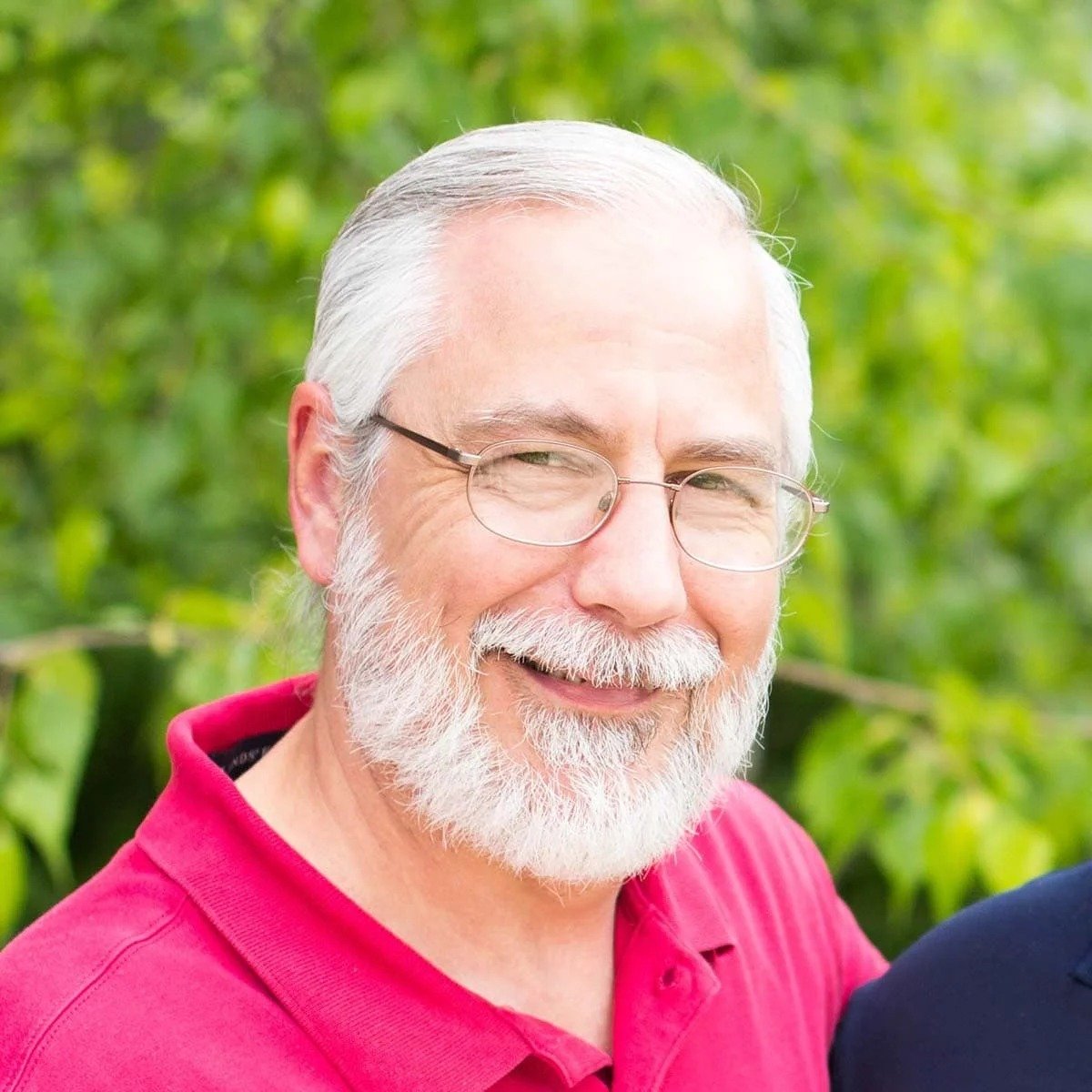
“It’s All About Relationships”: Dr. Dan Zink (MDiv ‘89)
Rick Matt (RM): Thanks for talking with me. I always look forward to these profiles and learning more about our wonderful faculty members. For folks who aren’t familiar with your story, could you please share a little about your background and how the Lord first brought you to Covenant Seminary?
Dan Zink (DZ): Thanks for asking me. It’s a long story but I’m happy to tell it. I usually start with the fact that I was born in Wisconsin, but when I was eight, my family moved to Quincy, Massachusetts. So, I call Massachusetts home. I know I don’t sound like I’m from there, but I am. That move was a big change for us, because my father had been the minister of a small Nazarene church in Madison, Wisconsin—a totally different denomination than the Reformed, with a more Wesleyan and Arminian view of things. When he was in college, my father had rheumatic fever and it damaged his heart, so he lived with that rather precariously for years, then died when he was 41. I was only five at the time; my brother Dave was 10, and my oldest brother Chuck was not quite 15. That was a hard loss for a young boy.
My mom thought it was wise that we stay in Madison so my oldest brother could finish high school there, then later she got a job as secretary to the president of the denominational college, a little regional one called Eastern Nazarene, in Quincy, Massachusetts. We moved there when I was 8 and Mom worked there for 10 or 11 years. I was always thankful for that move because it was a great small college with very much of a family atmosphere between faculty and staff. Our church was College Church on campus. My oldest brother, who had been attending Iowa State, ended up transferring to Eastern Nazarene. He played basketball for them, so everybody knew him, and everybody knew me. It was a great environment for a fatherless boy.
I was very much a Nazarene at that time. My oldest brother became a minister in the Nazarene Church and ended up being a well-known denominational figure before he died. I eventually married the daughter of a Nazarene college professor. After graduation, I did a master’s degree in social work at Ohio State University and started working as a social worker. I went to a Nazarene church there, and even ended up on their church board, though I was probably younger than I should have been to do that. In my late twenties and early thirties, I really struggled with theology. I was having conversations with my pastor and with my oldest brother, who had also been a social worker before going to the Nazarene seminary.
Part of my struggle was that as a social worker I was working a lot with kids in foster homes. I watched one time as an office mate and our supervisor arranged for a 15-year-old girl who was in foster care and pregnant to take a bus trip from Columbus, Ohio, to the state of Kentucky so she could get an abortion without parental consent. They facilitated that under the radar. Meanwhile, I was thinking of the 16-year-old girl and others that I was in charge of who were in foster homes, and I knew I might be in a similar position at some point. I knew I did not want to do that. I didn’t feel it was right. But I wasn’t hearing anything from my church in terms of how to back up my thoughts biblically. Around that time, I also I started reading Francis Schaeffer, and that was a big shift in my life.
Somewhere around the age of 30 or so, after I’d been working as social worker for about eight years, I felt called to go to seminary, but I knew I was not going to go to a Nazarene seminary. I wasn’t sure exactly what the Lord was doing. I thought maybe I would go study somewhere and get good theology then maybe be a missionary to Nazarenes. It was probably pretty naive of me. My wife, Carolanne, and I began visiting other kinds of churches, and I would ask some of those pastors for recommendations on seminaries, but I didn’t get much help. So, I ended up writing to three people, one of whom was Franky Schaeffer, the son of Francis Schaeffer. Francis had died in 1984, so this was sometime late that year or early 1985. I asked Franky if he could recommend a place that would really teach me the Bible and how it applies to current social issues. Franky actually wrote me back and said, “I’m an artist and not a professional theologian, so take this with a pinch of salt, but if I were you, I’d try Covenant Seminary in St. Louis.”
I’d never heard of it, but based on that recommendation I wrote to Covenant. Someone from the school wrote back—this was before the internet and email—and sent me a catalog. This was not like a picture book catalog, but one full of detailed writing about the school and the classes and the professors. My wife and I read it and were pleasantly surprised. We didn’t know there were people around who thought like this. It sounded exactly like what I needed. We sold our house and moved to St. Louis so I could do an MDiv because I thought I was going to be a pastor. With my social work background, I eventually got a job working as a counselor to support us, but for a while before that I worked at a grocery store stocking shelves from one to five in the morning, which had an effect on my studies. I still have some of my old class notes where the handwriting trails off as I fell asleep in class on occasion.
RM: So, if you came to Covenant to become a pastor, how did you end up as a Professor of Counseling?
DZ: Good question. When I graduated with my MDiv, Dr. Paul Kooistra, who was Covenant’s President at the time, helped me connect with a church in Dallas, Texas, which was pastored by a guy Dr. Kooistra knew from his years at Reformed Seminary. They needed an assistant pastor, and my brother Dave also lived in Dallas, so Carolanne and I went there. It was the first time Dave and I had lived in the same city since we were kids. Unfortunately, about six weeks after we got there, the church started to struggle, and some months later it split. The pastor got a job somewhere else and our church lost a lot of people. I knew they weren’t likely to hire a newbie like me to pastor the church, so I knew I was looking for a job as well.
I called Paul Kooistra and what happened was that Covenant eventually hired me to come back to the Seminary and restart the Student Services department, what we now call Student Life. There had been some staff changes and departures at the time, which had left no one to directly run Student Services; the Academic Dean had been covering it for a year, but that was not sustainable. So, I came back to Covenant to work, which was a surprise to me because I thought I was going be a pastor for the rest of my life. I ended up running Student Services for five years, working to rebuild it into something that would be beneficial and formative for the students. I had some awesome student workers on my staff—one of whom was Tom Gibbs, now our sixth President; another was Stephen Estock, who is now the Coordinator of the PCA’s Committee for Discipleship Ministries. We had a great time.
I was hired to be an administrator, but I also served as an adjunct instructor. In that role, I was like a utility player on a baseball team, playing whatever position was needed at any given time. Mostly I supervised the preaching of MDiv students. I did not expect to be on faculty in the future, but there was a fringe benefit of tuition reimbursement that you could pay back in years of service. I decided to use that to work on a graduate degree in Marriage and Family Counseling at Saint Louis University, even though I knew it was likely I would not be able teach at Covenant. But then, in that mysterious way that God does things, during my third year in Student Services, the Seminary was gearing up to start its Counseling program, which Dr. Richard Winter began in 1993. They knew my background in social work, so when Richard arrived, I got to work with him as a sort of consultant on the creation of the program. After it was up and running for two years, it was obvious we’d need a second counseling professor. I wasn’t quite finished with my PhD, but getting close, so I applied for the position. By God’s grace, I was hired and started teaching in the fall of 1995.
RM: And now you’ve been here for 30 years.
DZ: Thirty years as a teacher, but if you tack on my Student Services years and my student years before that, I’ve been around forever! One interesting thing about that is that I’ve known or worked with all six of our Presidents in some way. I had a couple of homiletics courses with Dr. Rayburn, knew Dr. Barker a little bit, was a member of Dr. Kooistra’s President’s Cabinet, and worked with Dr. Chapell, Dr. Dalbey, and now Dr. Gibbs. There aren’t too many folks around here now who can say that; maybe Jack Collins.
RM: I’m sure you’ve seen a lot of changes in your years at Covenant.
DZ: Sure have. When I first came here as a student, this building we’re sitting in, Founders Hall, didn’t exist. We still had the old white house that served as our administration building just down the hill. There were no apartments on campus, there was no Archeology Institute, the big Community Center did not exist. The walkway that now runs from Founders and in front of the Chapel over to Edwards Hall was a driveway. Most of the parking lots didn’t exist. We didn’t have as many students then, either. Everyone was very excited about our entering class in fall 1985 because there were 31 of us—that was the biggest class up to that time. It’s a strange feeling to now be in my 70s and know that a lot of the people and things that were so formative for me are not really known by most of our newer students and staff. But that’s what happens when you’ve been someplace for a very long time.
RM: As you look back over all those years, what people or events stand out to you? What have you learned or how have you grown as a person and as a teacher during your time here?
DZ: It’s not particularly Covenant-related, but one thing I’ve always been extremely thankful for is the fact that I was trained as a social worker before I became a counselor. Social work is a broader training, and it taught me a lot about organizations and what leadership looks like. Most importantly, it taught me that fundamentally you help people most through the relationships you have with them. From the very first course I taught here, I’ve made it a point to emphasize that the relationship is the vehicle of change. I’ve basically treated the classroom and the counseling room as the same kind of environment: my students and my clients both need the same thing from me, and that is to create a relationship with them where they know I’m tuned into them, that I’m for them, and that we’re collaborating. Because it really is collaborative. It’s not just me teaching down or counseling down to them. That has become more and more important to me through the years.
Another thing is that somewhere along the way I recognized that the main foci of my life were teaching, counseling, leadership, speaking, and writing. My professional life has really revolved around those things. My primary focus, though, is on the students. I’m very concerned that the forces of our culture and the information society we’ve been in for a quarter-century or so, have pressured schools to be about the transfer of information. But for me, a counseling program—or any program that prepares people for helping others—has to have at the heart of it the transformation of people. The heart of my work is to be as transforming a force as God allows me to be with the people he puts before me. And with that is hopefully to be a transforming force for the Seminary itself in whatever way I can during the time I have left here.
More directly related to Covenant is something that has been one of the greatest blessings to me personally. About 15 or so years ago the curriculum committee was revising the MDiv curriculum, looking at places where courses overlapped and where we might be able to combine some courses together. One of the things that came out of that was the course God and Humanity: Foundations of Counseling, which brings together elements of the theology of God and man and elements of the basics of counseling, since those two are intimately related. I got to be the counseling professor in that class from the beginning, which means that I’ve been in that classroom every semester for 15 and a half years.
The blessing of hearing my colleagues Mike Williams and then Robbie Griggs and Drew Martin teaching on the theology aspect and answering questions by going back to creation really formed something very deeply in me. They spoke about the reality that God established in creation and how he ordered things, and part of that ordering is that everything and everyone is in relationship, it’s all integrated, it’s all of a whole, and the healthiness or unhealthiness of those various integrated relationships affects everything else. It’s helped me realize as a counselor that we can’t really talk about integrating psychology and theology because they were never really separated to begin with. They were tied together at the start. That’s how God made things to work. We can break things apart to analyze them in more specific ways, but we can’t really understand creation or human beings unless you see them as a whole, and that includes relationships. We’re all individually image-bearers of God but, ultimately, we image him most fully when we are in relationship with others. I’m very grateful for those profound insights and how they have affected my teaching.
Besides these things, there have been so many people, so many colleagues and students and friends and guest speakers along the way who have had a great impact on me: Jerram Barrs, David Jones, and David Calhoun to name just a few. And Paul Kooistra, whose emphasis on grace during his time as President really helped transform the culture, people, and viewpoint of the Seminary in so many ways. All the good things that have been happening around here in recent years are really a continuation of that emphasis on being receivers of God’s amazing grace.
RM: Amen to that! One last question: We have lots of pastoral students who also do counseling degrees. How do you see those meshing together and how is that combination a benefit to the church?
DZ: I’ll answer that by reiterating what I said a minute ago about the importance of seeing each human being as an integrated whole, and just add that pastoral work, like counseling, is largely about helping people understand that about themselves. My belief is that the MDiv student who pursues a counseling degree can start to see that helping people through the means and context of relationship makes sense. That’s the best place to start because that’s the way God orders the world; that’s the way he made us.
It’s also important to not get hung up on thinking in counseling or psychological terminology. I was talking with one of our counseling grads about this recently, and he told me of a supervisor he had who required his people to write their client reports without using any kind of technical psychological jargon but to think in terms of the clients’ experience and write something closer to how they might describe that experience themselves. That was a challenge at first, but he soon found that doing it this way transformed the way he thought about people and about counseling. It gave him more of an awareness of who they were and how the things that happen to us in our lives—the good and the bad—happen through the means of relationship. People who hurt us and people who help us can only do so because there is a relationship in which they do that. That’s why knowing something of a person’s family history is so important.
That conversation just confirmed for me that the starting place for our counseling or our pastoral work is not just our understanding of God, but also how he created us to reflect him, to reflect something of the Trinity itself, which is in constant relationship. My hope is that our counseling students, because they take theology classes, will get that. And I hope that our MDiv students who also do counseling degrees, get it as well. It sounds so simple, but it’s so incredibly profound.
Note: This article first appeared in the fall 2025 edition of Covenant magazine. Get your copy or subscribe to Covenant here.