Of Sabbaticals, Scotland, and Saving Grace: Dr. Brian Aucker (MDiv ‘96)
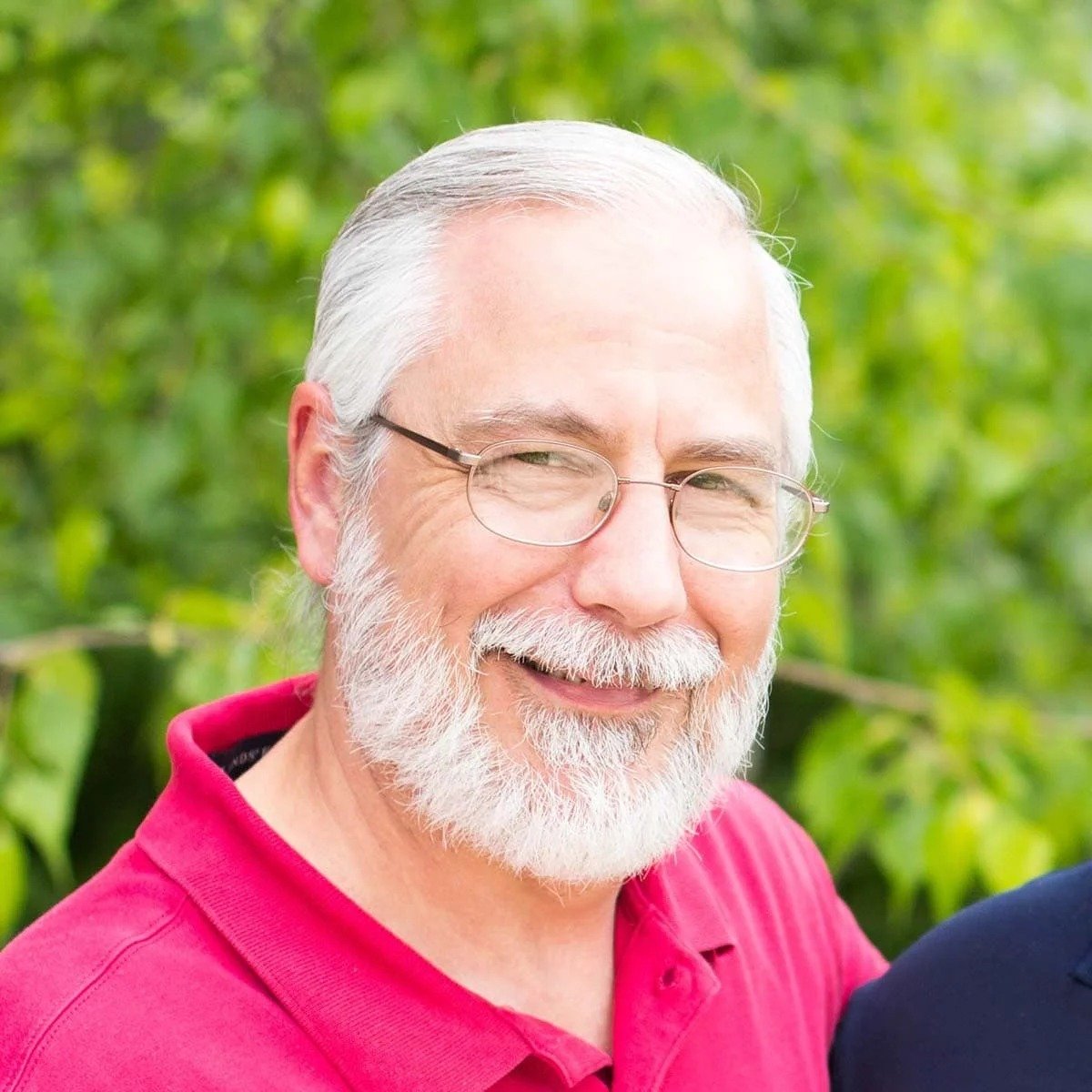
Dr. Brian Aucker his professional life as a nuclear medicine technologist helping doctors diagnose and treat ill people. Today, as Professor of Old Testament at Covenant Seminary, he helps prepare pastors and ministry leaders to bring hope and spiritual healing through the gospel. In this recent interview, he shares some of his remarkable journey.
Rick Matt (RM): Brian, thanks for agreeing to take time from your sabbatical to share your story with us. What have you been doing with your time while you’ve not been teaching this spring?
Brian Aucker (BA): Mostly, I’m working on a commentary on First Kings and trying to make progress on that. I’ve outlined it in detail and now I’m inductively firing questions at the text as I walk through it. I’m hoping that will help me make connections with things that come up later in the book so I can address them more thoroughly. It’s going well but slowly. That’s the main project right now. But I’m also trying to do some renovation work around my house. It needs a lot of help! It’s a huge undertaking; like a second job, really. We’ll see how it goes.
RM: Sounds like you’ll be very busy for the next several months! Like all our profs, I know you spend lots of time with students outside the classroom and often form deep friendships with them. But not everybody gets to hear the details of profs’ personal stories and how the Lord brought them to where they are today. Can you give us a sense your own story? How has God been working in the life of Brian Aucker?
BA: It’s hard to know where to begin, but I’ll start with this. A couple of years ago, my mother had an unexpected, extended illness which led to her death. I was one of her primary caregivers. One day she was particularly distressed, and I asked what the matter was. She said, “When you were born, I struggled with post-partum depression. I was concerned that I might kill you. So, I prayed that God would help me through that and if he did, I would dedicate you to him.” That was a strange thing to hear, especially since I didn’t grow up in a Christian home. We didn’t attend church at all. So this was news to me and got me thinking about how I got where I am.
I was a pretty good student as a kid and seemed to enjoy school, but for various reasons, I went off the rails in my high school and college years. There was absolutely no reason I should have gotten into college with my academic record. But I had played lacrosse in high school, which got me noticed by a college coach, so I ended up going to college based on that. I never really played because I was so off the rails at that point. But the Lord got hold of me in my sophomore year and began to straighten me out.
I was a biology major and I decided to pursue something called nuclear medicine. This was the early 1980s. Nuclear medicine is basically a branch of diagnostic radiology, using radiopharmaceuticals to help diagnose and treat various illnesses. Then in the mid-1980s magnetic resonance imaging became more clinically available as well. So, after college I worked for a company that did nuclear medicine and MRI, while my wife Pam and I got married and started our family. I did that all through my twenties.
I also worked at my church, doing some small group leadership and Sunday school teaching. I enjoyed it. I had been thinking about seminary and did some classes through a local seminary in Maryland called Chesapeake Theological Seminary. It had been started by a Covenant Seminary alumnus. At that time there weren’t any online or hybrid options, so the school was a way for people to continue to serve in their local congregations but also get better prepared for ministry. I also visited Covenant in 1986. One of the guys I stayed with on campus, Khen Tombing, had an incredible impact on me in such a short time. I was also deeply impressed by the sense I had of full-orbed, fully organic care for the students and community, for the whole family. My pastor at home had graduated from another seminary but he encouraged me to come here, which I decided to do.
Soon after that, though, I got a call from a physician I had trained with who was planning to build an MRI facility. He asked if I would be the technical director of that facility, which I agreed to do. So that led me in a very different direction for a couple of years. I didn’t get back to Covenant until 1992. By that time, I was 32 years old, but that’s the trajectory the Lord had me on. Of course, I needed a way to support my growing family while in seminary. It so happened that Missouri Baptist Hospital, just up the road, had a desperate need of someone with nuclear medicine experience. They hired me per diem, and I worked for them as much as I could all four years I was at Covenant.
RM: It sounds like the Lord took you on quite a roundabout path before bringing you here to study. How did you go from being a Covenant student to being a Covenant professor?
BA: That same kind of irregular path continued while I was a student. Early on, my parents went through a difficult divorce that impacted me, my brothers, and my mom for many years. But again, the Lord knew what he was doing. My first class here was summer Greek taught by Dr. Bob Yarbrough. There were many guys in that class who are now or were at some point professors and colleagues of mine, people who had a huge impact on me: Jimmy Agan, Zack Eswine, Mike Higgins, to name a few. Dan Doriani, Jack Collins, and Hans Bayer started teaching here near the end of my student years. But Dr. Phil Long really impacted me greatly with his Old Testament Historical Books class. His teaching on Samuel was remarkable. I had no idea this kind of narrative existed or that it was so rich. I hadn’t been raised in the church and I didn’t know the Bible well at all. How I even passed the Bible Content Exam I don’t know. It was definitely a Holy Spirit thing.
Phil was good friends with Iain Provan, who taught at Edinburgh and had written an excellent commentary on Kings, in which he talked about the need for the church to recapture the Old Testament. I had never heard that idea stated the way he said it. It grabbed me. Providentially, he happened to be coming to the States at one point, so Phil took a bunch of students to lunch with Iain and we got to know him a bit. Through that I decided I wanted to go to Edinburgh to study with him. The question was, how to make it happen financially. There was no way we could do it ourselves and my parents’ marriage was completely dissolving at this point. Then God providentially stepped in again. My wife had a “chance” encounter in the library on campus with someone who had heard about my interest in studying overseas and our need for financing. He said he knew someone who might be able to help and if we could get him a budget, he would see what he could do. We gave him that information, and then one day not long before I was set to graduate, our phone rang. It was this man and he said—and I quote— “I don’t know if you have a fattened calf but if you do you ought to slaughter it. I have someone who’s willing to give you $75,000.” And he came over and gave us a check for $25,000, with the promise of $25,000 more for the next couple of years. With no strings attached. To this day I have no categories for that. And that’s how I ended up going to Edinburgh to study.
RM: So, you got to study with Iain Provan, the guy who wrote that commentary you liked?
BA: Yes, but only partly. After the first year, Iain took a call to Regent College in Vancouver, which was a bit disheartening to me at the time. He eventually also convinced Phil Long to go to Regent, which is another twist in the story, because Phil then called me and asked if I’d like to come back to Covenant and teach his classes as an adjunct. I was thrilled to have that opportunity, so I said yes, and came back here in August of 2000. I had finished my classwork in Edinburgh, but my thesis wasn’t done yet, so that made things a bit challenging, having to prep for and teach all Phil’s classes while trying to finish the thesis. It was a hard time, but it taught me that I liked being in the classroom teaching. But around the time that school year was finishing up, there was a ministry opportunity at Covenant Church near the Seminary and I went to serve there as an assistant pastor. I did that for three years while looking for other academic positions. I felt increasingly that I was called to be in the classroom.
Then, once more through a connection I had with someone at the Seminary, I found out about the need for a Bible teacher at Westminster Christian Academy nearby. It was a great experience teaching high school students. They are remarkable. They don’t let you get away with anything. Adults will figure out ways to check out in the classroom without letting you know they’ve checked out. High schoolers just say, “You’re boring,” and put their heads on their desks. But it was a good experience. It certainly gave me a lot more practice in classes and grading and all of that. Then after about three years at Westminster, I got a call from the dean of academics at the Seminary asking if I’d be interested in applying for an OT position at Covenant. I said yes. That was in 2007 and I’ve been here ever since.
RM: It’s been quite a wild ride, hasn’t it?
BA: It certainly has. God has taken me on a remarkable journey to get to this point where I can use whatever gifts he’s given me for his glory. In the midst of that, I’m conscious of a sense of obligation and gratitude, of what we owe the Lord for his mercies and what he invests in us. Hardly a week goes by that I don’t think of the fact that someone, by God’s grace, had the funds to help me get to Scotland with no strings attached. That just doesn’t happen! But if you hang around Covenant long enough, you’ll find many people with similar stories of God’s amazing grace.
RM: I love hearing how God does his work in people’s lives. He never wastes anything, any experience.
BA: Yes, that’s true. All that experience in the medical world helped me as a pastor to know how things work so I was able to be a help and comfort to sick people and their families. Other people have similar stories of how the Lord somehow used their previous experience to benefit a new calling.
One of the great things about working at Covenant is that, when it’s appropriate, I can share with students the stories of God’s grace and providence in my life. I never take for granted the fact that I’m here or they’re here. I don’t deserve to be here and neither do they. I’m just a guy trying to do the job God brought me to using the gifts he gave me. I don’t know what he’s doing in their lives but I can encourage them with what he’s done in mine. They need to know that it’s not only the classroom stuff you need. The really big lessons come from just living life and trusting God in whatever is thrown your way. That’s the real preparation for ministry.
Note: This article first appeared in the spring 2024 edition of Covenant magazine. Get your copy or subscribe to Covenant here.